Thursday, July 26, 2012



Wednesday, July 25, 2012
F-22 oxygen supply problem not a contamination issue
From Flightglobal:
The USAF has also gathered data that indicates that the problem has to do with the amount of oxygen that is reaching the pilot, Schwartz says. Based on tests conducted inside an altitude chamber and a centrifuge, the USAF has concluded that a combination of hardware defects with the pilot's life support gear contributed to the problem.Source
"Part of that is the upper pressure garment of the g-suit assembly," Schwartz says. "Part of that has to do with hose and valve and connection hardware in the cockpit."
Wednesday, July 18, 2012
The Messenger Lectures - Richard P. Feynman
Richard Feynman's lectures on physics at Cornell University in 1964. Microsoft Research's Project Tuva has added to these videos by including commentary, notes and extras. All seven videos are available here.
Note: The site linked above requires Microsoft Silverlight to be installed for your browser.
Alternatively, you could watch the videos on YouTube (without all the Project Tuva additions though):
Note: The site linked above requires Microsoft Silverlight to be installed for your browser.
Alternatively, you could watch the videos on YouTube (without all the Project Tuva additions though):
Sunday, July 15, 2012
Photo - chalk as examined by Thomas Huxley in the 1860s
From NPR's 'Krulwich Wonders...' - A science blog by Robert Krulwich (excerpt follows):

Find more posts at: http://www.npr.org/blogs/krulwich/
Read more..
"Chalk is composed of extremely small white globules. They look, up close, like snowballs made from brittle paper plates. Those plates, it turns out, are part of ancient skeletons that once belonged to roundish little critters that lived and floated in the sea, captured a little sunshine and carbon, then died and sank to the bottom. There still are trillions of them floating about in the oceans today, sucking up carbon dioxide, pocketing the carbon. Over the millennia, so many have died and plopped on top of each other, the weight of them and the water above has pressed them into a white blanket of rock, entirely composed of teeny skeletons. Scientists call these ancient plates "coccoliths." Technically, they are single-celled phytoplankton algae.
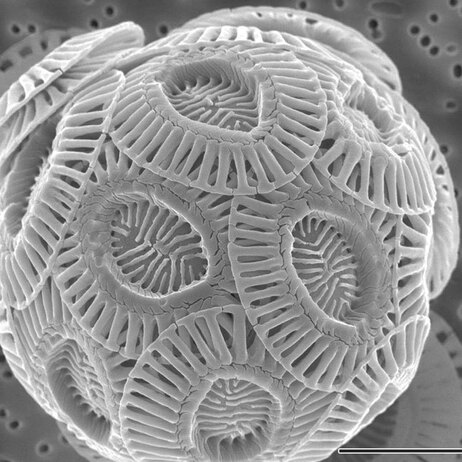
Chalk doesn't proclaim itself. It is usually out of view, buried in the ground below. Every so often, when a highway is being carved through a mountain, or when the sea and wind erode the side of a hill, that's when the green cover comes off, then you can see it. The White Cliffs of Dover are all chalk, piled hundreds of feet high."
Find more posts at: http://www.npr.org/blogs/krulwich/
Read more..
Slick public service message on viruses
Warner Bros and Participant Media create a rather well produced public service message for Take Part's pandemic and disease prevention campaign:
Subscribe to:
Posts (Atom)