http://www.itsokaytobesmart.com/post/64309813908/william-blake-auguries-of-innocence-gif

Showing posts with label science//engineering. Show all posts
Showing posts with label science//engineering. Show all posts
Monday, October 21, 2013

Thursday, January 10, 2013
Landmark achievement in natural history film-making
The first footage of a giant squid in its habitat was captured by a team from NHK and the Discovery Channel. The Japanese broadcaster will air a special documentary on 13 January followed by Discovery on the 27th.

Sources: Discovery & LA Times
"The video of the giant squid was shot 2,000 feet below the North Pacific Ocean, about 260 miles south of Tokyo.Scientists on the squid-finding mission had hoped to film at least a tentacle or two, but they got lucky: By the time the expedition was over, they had collected more than 23 minutes of the giant squid in the murky deep."
Monday, December 10, 2012
Sunday, September 9, 2012
"How long is a piece of string?"
A BBC Horizon documentary with Alan Davies (of QI: Quite Interesting fame) exploring the intricacies of measurement - from rulers to thought experiments and quantum mechanics.
Overall, the science and maths is a tad over simplified; I feel viewers could handle a little more detail.
Via
Overall, the science and maths is a tad over simplified; I feel viewers could handle a little more detail.
Via
Wednesday, July 18, 2012
The Messenger Lectures - Richard P. Feynman
Richard Feynman's lectures on physics at Cornell University in 1964. Microsoft Research's Project Tuva has added to these videos by including commentary, notes and extras. All seven videos are available here.
Note: The site linked above requires Microsoft Silverlight to be installed for your browser.
Alternatively, you could watch the videos on YouTube (without all the Project Tuva additions though):
Note: The site linked above requires Microsoft Silverlight to be installed for your browser.
Alternatively, you could watch the videos on YouTube (without all the Project Tuva additions though):
Sunday, July 15, 2012
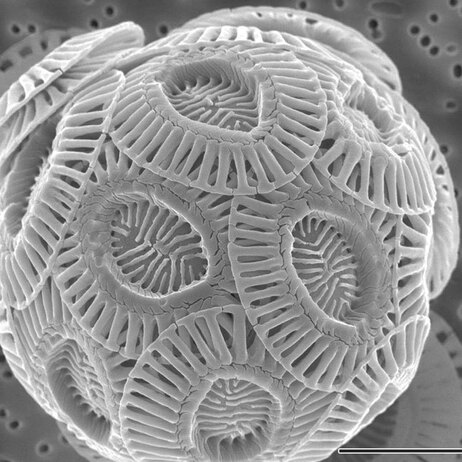
Photo - chalk as examined by Thomas Huxley in the 1860s
From NPR's 'Krulwich Wonders...' - A science blog by Robert Krulwich (excerpt follows):
Find more posts at: http://www.npr.org/blogs/krulwich/
Read more..
"Chalk is composed of extremely small white globules. They look, up close, like snowballs made from brittle paper plates. Those plates, it turns out, are part of ancient skeletons that once belonged to roundish little critters that lived and floated in the sea, captured a little sunshine and carbon, then died and sank to the bottom. There still are trillions of them floating about in the oceans today, sucking up carbon dioxide, pocketing the carbon. Over the millennia, so many have died and plopped on top of each other, the weight of them and the water above has pressed them into a white blanket of rock, entirely composed of teeny skeletons. Scientists call these ancient plates "coccoliths." Technically, they are single-celled phytoplankton algae.
Chalk doesn't proclaim itself. It is usually out of view, buried in the ground below. Every so often, when a highway is being carved through a mountain, or when the sea and wind erode the side of a hill, that's when the green cover comes off, then you can see it. The White Cliffs of Dover are all chalk, piled hundreds of feet high."
Find more posts at: http://www.npr.org/blogs/krulwich/
Read more..
Saturday, July 14, 2012
An astrophysicist's poetic act of revenge in 1984
From Maria Popova's fantastic 'Brain Pickings':
A Vintage Scientific Paper Published as a 38-Stanza Poem:
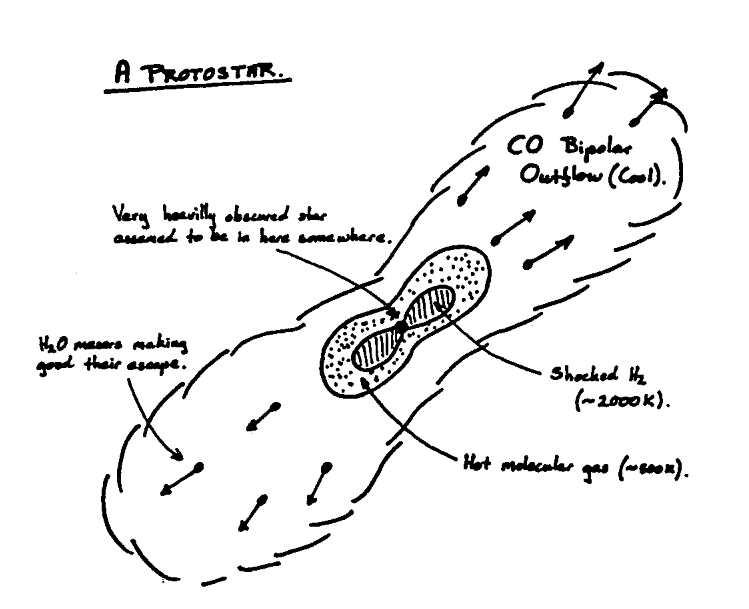
...Reader Julia Deneva, a Cornell astronomer and fellow Bulgarian, alerts me to The Detection of Shocked Co/ Emission from G333.6-0.2 by New South Wales physicist J. W. V. Storey, a paper published as a 38-stanza poem, appeared in The Proceedings of the Astronomical Society of Australia in 1984. It was as much an act of creativity as it was one of vengeance. Deneva writes:
"The unfortunate astronomer who got scheduled last at the annual meeting of said society decided to take revenge and gave his talk in verse — and later submitted it for publication."
The first few stanzas:
I wrote my abstract, sent it in,With words that don’t offend.Imagine my horror to find that IAm scheduled at the end.
Let me say, to be last speaker,There are very few things worse.And so this talk, to get revenge,Will be entirely in verse.
The subject I address todayIs that of star formation.And what we’ve found out recentlyAbout the situation.
Stars start out as clouds of gas andDust and bits of spinning stuff.Collapsing gravitationallyUntil they’re dense enough.
They form themselves in little lumps,(Or so says this bloke Jeans).‘Dynamic Instabilities’Whatever that term means.
Source
Thursday, July 12, 2012
Dark Matter - Unaccounted for
From Quantum Diaries :
Full post can be found here.
Neal Weiner, a theorist from New York University, started his lecture saying that contrary to the Higgs boson, for dark matter “we have no model, only guesses”. There is nothing within the Standard Model of particle physics to account for dark matter. This is one key reason we physicists are all convinced there is a bigger theory hiding behind the current known one.
So theorists and experimentalists are in the dark… As Neal stressed, there are many manifestations of dark matter. Different experiments observe strange signals where dark matter could be the explanation. But formulating an explanation is far from being trivial.
Full post can be found here.
Wednesday, July 11, 2012
Wednesday, July 4, 2012
Explained: Sigma - MIT News Office
Given the news we've just heard from CERN, this simple explanation from MIT (Feb 9, 2012) offers some insight into the magnitude of today's announcement. I'll collect many more links/resources to provide a more thorough picture of this discovery.
Explained: Sigma - MIT News Office
Explained: Sigma - MIT News Office
Wednesday, June 27, 2012
Human birth as viewed through an MRI machine
From Medical Daily:
"The 30-second movie captures the active second stage of labor as the mother makes expulsive efforts to push out the fetus. Researchers had to stop recording in the late second stage as the fetal head extended and from the mother to ensure that the ears of the newborn were still covered by maternal soft tissue so that it was not exposed to MRI noise."
Von Karman Vortices with a Pair of Rainbows
From New Scientist:

Source: http://www.newscientist.com/blogs/shortsharpscience/2012/06/swirls-and-glories.html
" The layer of stratocumulus clouds normally reflects a portion of solar energy into space and in this image the clouds are diffracting the sunlight back to the satellite splitting the light into its constituent colours.
...Von Karman vortices are linear series of alternating spiral eddies formed by a fluid moving round an obstacle, in this case it is the clouds moving around the island. "
Source: http://www.newscientist.com/blogs/shortsharpscience/2012/06/swirls-and-glories.html
Friday, June 22, 2012
Irrationality & Intelligence -- Two of a kind?

From Jonah Lehrer's blog, Frontal Cortex (The New Yorker):
Here’s a simple arithmetic question: A bat and ball cost a dollar and ten cents. The bat costs a dollar more than the ball. How much does the ball cost?The vast majority of people respond quickly and confidently, insisting the ball costs ten cents. This answer is both obvious and wrong. (The correct answer is five cents for the ball and a dollar and five cents for the bat.)
For more than five decades, Daniel Kahneman, a Nobel Laureate and professor of psychology at Princeton, has been asking questions like this and analyzing our answers. His disarmingly simple experiments have profoundly changed the way we think about thinking. While philosophers, economists, and social scientists had assumed for centuries that human beings are rational agents—reason was our Promethean gift—Kahneman, the late Amos Tversky, and others, including Shane Frederick (who developed the bat-and-ball question), demonstrated that we’re not nearly as rational as we like to believe.
When people face an uncertain situation, they don’t carefully evaluate the information or look up relevant statistics. Instead, their decisions depend on a long list of mental shortcuts, which often lead them to make foolish decisions. These shortcuts aren’t a faster way of doing the math; they’re a way of skipping the math altogether. Asked about the bat and the ball, we forget our arithmetic lessons and instead default to the answer that requires the least mental effort.
Although Kahneman is now widely recognized as one of the most influential psychologists of the twentieth century, his work was dismissed for years. Kahneman recounts how one eminent American philosopher, after hearing about his research, quickly turned away, saying, “I am not interested in the psychology of stupidity.”
Read more http://www.newyorker.com/online/blogs/frontal-cortex/2012/06/daniel-kahneman-bias-studies.html#ixzz1yVfbNgld
Tuesday, April 10, 2012
Sunday, January 22, 2012
Thursday, January 19, 2012
The Royal Institution's New Video Collection - Science, Maths, Nature, Engineering, Space, Environment etc!
This looks like a great showcase of science vids! For a start:
Oh, and of course, they have all their Christmas Lectures too.
Here's an example:
The creator, Matthias Wandel, has a website too --> http://woodgears.ca/ (An Engineer's Approach to Woodworking)
New Process Promises Drag Reducing Coatings for Marine/Aero Applications
Infrared Radiation-Assisted Evaporative Lithography:
News via Tim Robinson (@RAeSTimR) https://twitter.com/#!/RAeSTimR :
Link to the University of Surrey news release: http://www.surrey.ac.uk/mediacentre/press/2011/68467_new_coatings_process_to_reduce_the_carbon_footprint_of_the_transport_industry.htm
Link to a PDF presentation introducing the chemical process (from 2010): http://tinyurl.com/7ok87c6
MIT Researchers Find Critical Speed Above which Birds - and Drones - are Sure to Crash
Emilio Frazzoli, associate professor of aeronautics and astronautics at MIT explains his concept of a 'theoretical speed limit' for birds and aircraft alike. He and his research student argue that regardless of the apriori knowledge available to said bird/UAV about their terrain, a critical speed exists beyond which a collision is highly probable.
Results of his research could mean faster UAVs that do not simply rely on sensor data but engineered intuition.
"When you go skiing off the path, you don't ski in a way that you can always stop before the first tree you see," Frazzoli says. "You ski and you see an opening, and then you trust that once you go there, you'll be able to see another opening and keep going."
Source: http://www.eurekalert.org/pub_releases/2012-01/miot-mrf011912.php
Results of his research could mean faster UAVs that do not simply rely on sensor data but engineered intuition.
"When you go skiing off the path, you don't ski in a way that you can always stop before the first tree you see," Frazzoli says. "You ski and you see an opening, and then you trust that once you go there, you'll be able to see another opening and keep going."
Source: http://www.eurekalert.org/pub_releases/2012-01/miot-mrf011912.php
Sunday, November 27, 2011
Conflict Resolution: Newton, Bernoulli and 'Lift'
A professor of mine from university put together a superb essay for The Physics Teacher clarifying the concept of aerodynamic lift and how it can be best described by either Newton or Bernoulli's laws. Although this targets educators, undergrad engineering/physics students would probably appreciate the accessibility of this essay.
-k
-k
Subscribe to:
Posts (Atom)