http://www.itsokaytobesmart.com/post/64309813908/william-blake-auguries-of-innocence-gif

Monday, October 21, 2013

Sunday, May 26, 2013
Why is the ISS in a low-earth orbit?
random q why is the ISS in low earth orbit? doesn't that mean they expend more fuel in the long run boosting it? @thekarachikid @imzeesh
— takhalus (@takhalus) May 25, 2013
Takhalus, I thought I'd flesh out a slightly better answer for you over here!
To answer the first part of your question, 'Why is the ISS in low earth orbit?' (or LEO as it is commonly abbreviated) we need to define what LEO is.
Simply put, a low earth orbit is any orbit that extends from the surface of the Earth to an altitude of 2,000 km (approx. 1,243 miles). However, this is a rather general definition; after all you probably don't want something orbiting at an altitude of, say, 10,000 ft for a number of practical reasons - 1) It could...smack into a mountain, 2) at that altitude it may be a tad bit annoying for pilots (or the odd skydiver), and 3) the atmospheric drag will want to bring it down rather quickly (the atmosphere 'thins out' with altitude)
So what you may see defined as the LEO range in a lot of textbooks is 150 - 1000 km, well above significant drag producing atmosphere but well below the Van Allen radiation belts which start at around an altitude of 2,400 km.
Ok, so with the range defined more or less, why operate here? Well, the ISS being a manned research station requires frequent support from spacecraft delivering supplies, removing waste and changing crew. It would be desirable then to not have to travel too far to get to the ISS which happens to orbit Earth at an altitude of about 340 km.
Secondly, those radiation belts mentioned above, are bad news for electrical systems and the astronauts aboard. Charged particles can penetrate any of the modules that make up the ISS and interact with the electrons within computer systems creating false values or causing component failure. All satellites, spacecraft and high altitude aircraft have some kind of shielding or 'radiation hardening' built-in to discourage such phenomena but there's no perfect solution and this is an active area of research and development.
Note: The Van Allen belts aren't the only source of radiation. Cosmic rays play a large role in disrupting systems too (on Earth, and in space). CCD (charge-coupled device) imagers used in astro-photography often detect cosmic rays, which show up on the captured image as an artifact. CCDs have electron wells for each pixel, and cosmic rays interact with these wells exciting electrons just as photons of light are intended to do to create an image. There are other sources of radiation as well - Solar activity etc.
Lastly, reliable communication with the ISS is of concern too, and in an LEO signal delays are minimised (low latency).
So, LEOs are great if you have to make regular trips, avoid radiation and maintain reliable communication. The disadvantages?
Although, LEOs are above the significant drag producing atmosphere (above 80 km), that doesn't completely eliminate the problem. The atmosphere still exists at low-earth orbit altitudes, and as thin as it may be it still produces some drag.- enough to rob the ISS of its energy and cause orbital decay. The station's orbit is maintained by regular boosts given to it by it's own support module (Zvezda), the visiting Progress supply spacecraft, the European Space Agency's ATV service module, or in the past, by the Space Shuttle Orbiter.
Additionally, a Solar maxima will heat the atmosphere increasing the altitude of the drag producing region. As a result, orbital energy will be robbed at a higher rate and larger corrections will be required (See figure below).
 |
| This plot shows the orbital height of the ISS over the last year. Clearly visible are the re-boosts which suddenly increase the height, and the gradual decay in between. The height is averaged over one orbit, and the gradual decrease is caused by atmospheric drag. As can be seen from the plot, the rate of descent is not constant and this variation is caused by changes in the density of the tenuous outer atmosphere due mainly to solar activity. (Source) |
Note: The ISS's operates within an altitude range of approx. 280 km - 470 km. The upper limit is also governed by the performance of the supply spacecrafts that have to successfully dock with station.
Another disadvantage of LEO is the high orbital speed (~8km/s). For objects that need to remain over certain regions of Earth for an extended period of time, like a telecommunications satellite, this orbit doesn't work out quite so well. This isn't really an issue for the ISS's mission.
Hope this helps - I've included the 'NASA Reference Guide to the ISS' and a diagram detailing various orbits from LEOs to HEOs.
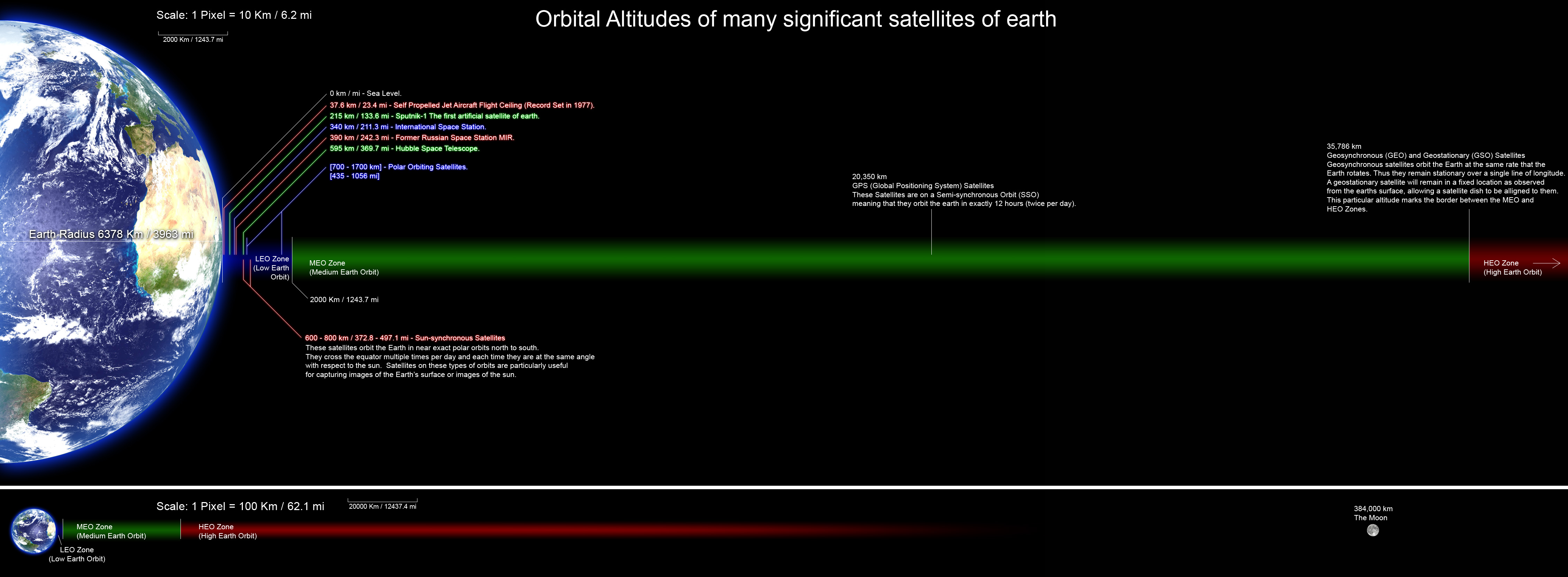
NASA - Reference Guide to the International Space Station
Monday, January 21, 2013
Jupiter - Moon Rendezvous (live webcast 2100 EST)
Link to the webcast:
http://events.slooh.com/
From the SLOOH Space Camera website -

http://events.slooh.com/
From the SLOOH Space Camera website -
"Bright planet Jupiter will be to the left of a spectacular Waxing Gibbous Moon - closest conjunction until 2026 for North America. "
From Space.com -
"Jupiter and the moon will appear just a finger-width apart tonight (Jan. 21) for stargazers across North America. In South America, some observers may even see Jupiter slip behind the moon in an amazing occultation. The extreme close encounter between the planet and moon is a must-see, even if clouds block your view."

Thursday, January 10, 2013
Landmark achievement in natural history film-making
The first footage of a giant squid in its habitat was captured by a team from NHK and the Discovery Channel. The Japanese broadcaster will air a special documentary on 13 January followed by Discovery on the 27th.

Sources: Discovery & LA Times
"The video of the giant squid was shot 2,000 feet below the North Pacific Ocean, about 260 miles south of Tokyo.Scientists on the squid-finding mission had hoped to film at least a tentacle or two, but they got lucky: By the time the expedition was over, they had collected more than 23 minutes of the giant squid in the murky deep."
Sunday, December 30, 2012
Jupiter - 29th December viewing
We finally received the filter and eyepiece kit and attempted another viewing of Jupiter. The orange and yellow filters enhanced details of the Jovian belts and general atmospheric structure, while the extra eyepieces provided some much needed magnification options.


Unfortunately, without the SLR kit (still waiting on it) we couldn't attempt any real astrophotography. Relegated to using the Samsung S3's camera again, the 25mm Plossol coupled with a 2x Barlow, and a Moon filter (the orange and yellow filters didn't seem to agree with the cellphone camera) managed to provide us a reasonable picture of Jupiter (below).

Equipment list: Celestron NexStar 6SE - (25mm Plossl eyepiece & 2x Barlow) // Imaging - Samsung Galaxy S3
Who: Ayushi/Rajat/Kashif
When: 20:59 hrs, 29th Dec, 2012

Unfortunately, without the SLR kit (still waiting on it) we couldn't attempt any real astrophotography. Relegated to using the Samsung S3's camera again, the 25mm Plossol coupled with a 2x Barlow, and a Moon filter (the orange and yellow filters didn't seem to agree with the cellphone camera) managed to provide us a reasonable picture of Jupiter (below).
Who: Ayushi/Rajat/Kashif
When: 20:59 hrs, 29th Dec, 2012
Thursday, December 27, 2012
Post-Christmas day observations
As an update to yesterday's post we'd like to share our photos from today's attempt at capturing the Moon and Jupiter. In addition, we managed to catch a speck of light known as Aldebaran, a rather bright red giant star some 65 light years (that's 614.9 million million kilometres) from us.
Beginning with the Moon again -

 Our final image of the day was a capture of Aldebaran (from the Arabic, Al-debaran, 'the follower').
Equipment list: Celestron NexStar 6SE - Stock setup (25mm Plossl eyepiece and a wonky StarFinder) // Imaging - Samsung Galaxy S3
Who: Ayushi/Rajat/Kashif
When: 1800 hrs, 26th Dec, 2012
Beginning with the Moon again -
 |

Today's observation of Jupiter and its moons displays the three closest moons forming a skewed triangle of sorts. Callisto, the fourth and farthest Galilean moon can be seen as a faint dot away from the trio.
 |
| Jupiter + 4 Galilean moons
The diagram below (screen capture from Sky & Telescope's handy Jupiter applet) indicates the predicted position of the Galilean moons with respect to the giant planet. As before the letters denote each moon's name:
I = Io, E = Europa, G = Ganymede, C = Callisto
|

 |
| Aldebaran (Red giant star)
Since we were unable to capture a wide angle image of our objects of interest, we've included a screen shot from Stellarium (a free to download interactive planetarium) illustrating the relative positions of all three objects.
|
 |
Equipment list: Celestron NexStar 6SE - Stock setup (25mm Plossl eyepiece and a wonky StarFinder) // Imaging - Samsung Galaxy S3
Who: Ayushi/Rajat/Kashif
When: 1800 hrs, 26th Dec, 2012
Wednesday, December 26, 2012
Christmas astronomy - The Moon & Jupiter
Most people around the world were treated to a great view of a waxing moon paired with Jupiter this Christmas night. The astronomical event presented itself to be the best way to start using our newly acquired telescope!
The Moon was spectacular offering plenty of detail (although at this stage of it's cycle it's increased brightness reduces contrast), and Jupiter was clearly visible with it's majestic bands and four Galilean moons - Europa, Io, Ganymede and Callisto - And since none of us had seen Jupiter through a telescope before, we were all rather chuffed.
Although we'd not yet received our astrophotography kit, we shivered through the sub-zero temperatures (a crisp -20 deg C) here in Cedar Rapids, Iowa to grab a few shots through the eyepiece with our cellphone cameras. Granted the images are really low-quality, we're happy we got anything at all on our very first astronomy outing!
Beginning with the Moon -


Using a cellphone camera our shot of Jupiter and its four Galilean moons couldn't obviously produce the detail we observed through the eyepiece. The image below is untouched and includes distortion due to the eyepiece barrel and the fact that we were trying to keep a cellphone centered at -25 degrees Celcius.

Attempting to clean up and re-size our original image gave us something a tad clearer (below).

Both the observed and captured image above were 'mirror reversed' since our telescope is a Schmidt-Cassegrain design. A comparison between a 'direct' view versus the captured view is shown below. The rendering is a screen capture from Sky & Telescopes' Jupiter's Moons applet available here.
Note: E = Europa, I = Io, G = Ganymede, C = Callisto
Equipment list: Celestron NexStar 6SE - Stock setup (25mm Plossl eyepiece and a wonky StarFinder) // Imaging - Samsung Galaxy S3
Who: Ayushi/Rajat/Kashif
When: 1830 hrs, 25th Dec, 2012
The Moon was spectacular offering plenty of detail (although at this stage of it's cycle it's increased brightness reduces contrast), and Jupiter was clearly visible with it's majestic bands and four Galilean moons - Europa, Io, Ganymede and Callisto - And since none of us had seen Jupiter through a telescope before, we were all rather chuffed.
Although we'd not yet received our astrophotography kit, we shivered through the sub-zero temperatures (a crisp -20 deg C) here in Cedar Rapids, Iowa to grab a few shots through the eyepiece with our cellphone cameras. Granted the images are really low-quality, we're happy we got anything at all on our very first astronomy outing!
Beginning with the Moon -
Using a cellphone camera our shot of Jupiter and its four Galilean moons couldn't obviously produce the detail we observed through the eyepiece. The image below is untouched and includes distortion due to the eyepiece barrel and the fact that we were trying to keep a cellphone centered at -25 degrees Celcius.
Both the observed and captured image above were 'mirror reversed' since our telescope is a Schmidt-Cassegrain design. A comparison between a 'direct' view versus the captured view is shown below. The rendering is a screen capture from Sky & Telescopes' Jupiter's Moons applet available here.
Note: E = Europa, I = Io, G = Ganymede, C = Callisto
 |
| From Sky & Telescope (SCT mirrored) |
 |
| From Sky & Telescope (Direct view) |
Equipment list: Celestron NexStar 6SE - Stock setup (25mm Plossl eyepiece and a wonky StarFinder) // Imaging - Samsung Galaxy S3
Who: Ayushi/Rajat/Kashif
When: 1830 hrs, 25th Dec, 2012
 |
| Merry Christmas! |
Monday, December 10, 2012
Saturday, September 22, 2012
Sunday, September 9, 2012
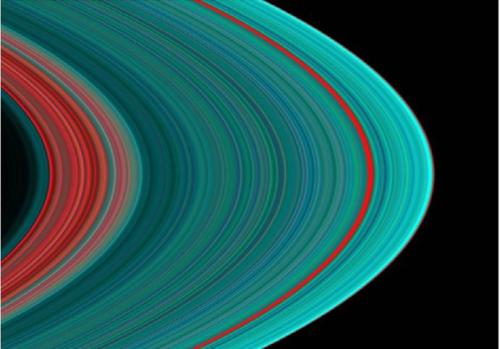

Vanity.
From 'The Verge':

Source
"NASA's original photo is somewhat obscured by a dust cover on the MAHLI camera used to capture the picture, but The Planetary Society's Emily Lakdawalla made the necessary touchups to reveal the memorable portrait above. That large "eye" you're looking at is actually one of Curiosity's most vital tools: it's a powerful laser capable of vaporizing Mars rocks and instantly analyzing their chemical composition as they vanish from sight."
"How long is a piece of string?"
A BBC Horizon documentary with Alan Davies (of QI: Quite Interesting fame) exploring the intricacies of measurement - from rulers to thought experiments and quantum mechanics.
Overall, the science and maths is a tad over simplified; I feel viewers could handle a little more detail.
Via
Overall, the science and maths is a tad over simplified; I feel viewers could handle a little more detail.
Via
This was overdue
To be watched in HD only!
Video description:
"From the upcoming Special Edition Ascent: Commemorating Space Shuttle DVD/BluRay by NASA/Glenn a movie from the point of view of the Solid Rocket Booster with sound mixing and enhancement done by the folks at Skywalker Sound. The sound is all from the camera microphones and not fake or replaced with foley artist sound. The Skywalker sound folks just helped bring it out and make it more audible."
Thursday, July 26, 2012
Remembering Sally Ride



Wednesday, July 25, 2012
F-22 oxygen supply problem not a contamination issue
From Flightglobal:
The USAF has also gathered data that indicates that the problem has to do with the amount of oxygen that is reaching the pilot, Schwartz says. Based on tests conducted inside an altitude chamber and a centrifuge, the USAF has concluded that a combination of hardware defects with the pilot's life support gear contributed to the problem.Source
"Part of that is the upper pressure garment of the g-suit assembly," Schwartz says. "Part of that has to do with hose and valve and connection hardware in the cockpit."
Wednesday, July 18, 2012
The Messenger Lectures - Richard P. Feynman
Richard Feynman's lectures on physics at Cornell University in 1964. Microsoft Research's Project Tuva has added to these videos by including commentary, notes and extras. All seven videos are available here.
Note: The site linked above requires Microsoft Silverlight to be installed for your browser.
Alternatively, you could watch the videos on YouTube (without all the Project Tuva additions though):
Note: The site linked above requires Microsoft Silverlight to be installed for your browser.
Alternatively, you could watch the videos on YouTube (without all the Project Tuva additions though):
Sunday, July 15, 2012
Photo - chalk as examined by Thomas Huxley in the 1860s
From NPR's 'Krulwich Wonders...' - A science blog by Robert Krulwich (excerpt follows):

Find more posts at: http://www.npr.org/blogs/krulwich/
Read more..
"Chalk is composed of extremely small white globules. They look, up close, like snowballs made from brittle paper plates. Those plates, it turns out, are part of ancient skeletons that once belonged to roundish little critters that lived and floated in the sea, captured a little sunshine and carbon, then died and sank to the bottom. There still are trillions of them floating about in the oceans today, sucking up carbon dioxide, pocketing the carbon. Over the millennia, so many have died and plopped on top of each other, the weight of them and the water above has pressed them into a white blanket of rock, entirely composed of teeny skeletons. Scientists call these ancient plates "coccoliths." Technically, they are single-celled phytoplankton algae.
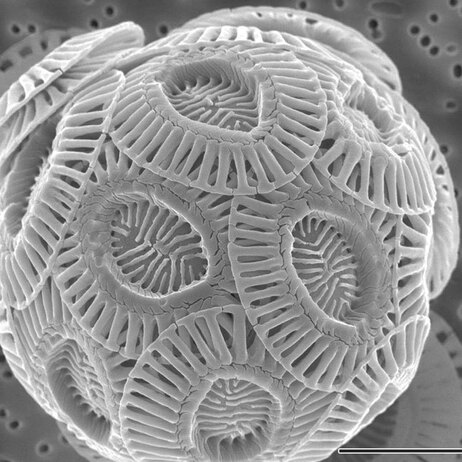
Chalk doesn't proclaim itself. It is usually out of view, buried in the ground below. Every so often, when a highway is being carved through a mountain, or when the sea and wind erode the side of a hill, that's when the green cover comes off, then you can see it. The White Cliffs of Dover are all chalk, piled hundreds of feet high."
Find more posts at: http://www.npr.org/blogs/krulwich/
Read more..
Slick public service message on viruses
Warner Bros and Participant Media create a rather well produced public service message for Take Part's pandemic and disease prevention campaign:
Saturday, July 14, 2012
An astrophysicist's poetic act of revenge in 1984
From Maria Popova's fantastic 'Brain Pickings':
A Vintage Scientific Paper Published as a 38-Stanza Poem:
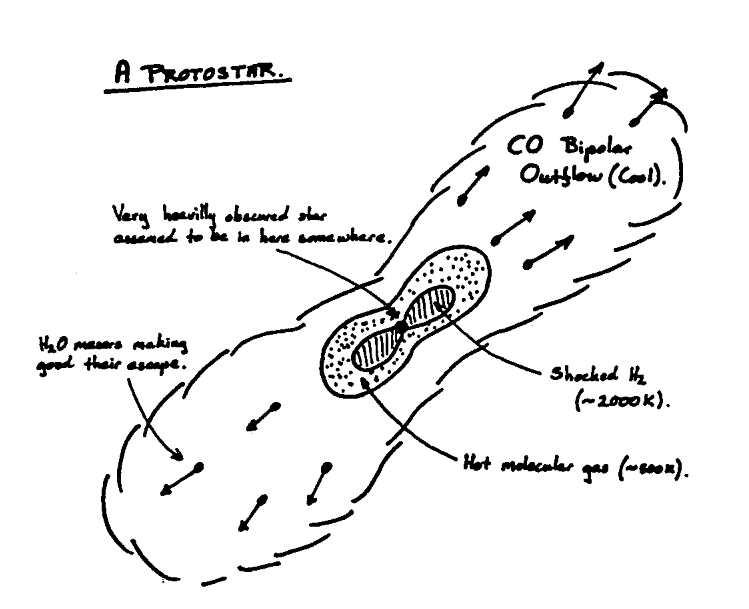
...Reader Julia Deneva, a Cornell astronomer and fellow Bulgarian, alerts me to The Detection of Shocked Co/ Emission from G333.6-0.2 by New South Wales physicist J. W. V. Storey, a paper published as a 38-stanza poem, appeared in The Proceedings of the Astronomical Society of Australia in 1984. It was as much an act of creativity as it was one of vengeance. Deneva writes:
"The unfortunate astronomer who got scheduled last at the annual meeting of said society decided to take revenge and gave his talk in verse — and later submitted it for publication."
The first few stanzas:
I wrote my abstract, sent it in,With words that don’t offend.Imagine my horror to find that IAm scheduled at the end.
Let me say, to be last speaker,There are very few things worse.And so this talk, to get revenge,Will be entirely in verse.
The subject I address todayIs that of star formation.And what we’ve found out recentlyAbout the situation.
Stars start out as clouds of gas andDust and bits of spinning stuff.Collapsing gravitationallyUntil they’re dense enough.
They form themselves in little lumps,(Or so says this bloke Jeans).‘Dynamic Instabilities’Whatever that term means.
Source
Subscribe to:
Posts (Atom)